

In many chains, the answer to “why did this rack trigger an alert again?” already exists. However, that answer is scattered across a dashboard, last week's report or the experience of a specialist who is not on call at that moment.
So the problem is rarely a lack of data. Most of the time, what is missing is quick access to what that data means.
Operational knowledge still depends on a few people
Over the years, supermarkets and cash & carry stores have accumulated information in systems, dashboards and reports. Even so, interpreting that information is still the job of a few specialists.
In practice, when an alert appears outside business hours, the store team has to find someone who knows how to read that data. Likewise, a manager who wants to compare the performance of two stores depends on someone else to put the analysis together.
On top of that, the sector lives with turnover above 58% a year. As a result, every time an experienced professional leaves, part of the knowledge about the operation goes with them. Newcomers have to relearn it while the store keeps running.
The impact on margin
Energy, maintenance and losses are usually treated as separate cost centers. However, all three reflect the same problem: an operation with little visibility and a weak ability to prioritize.
Energy accounts for 2% to 3% of food retail revenue, while maintenance is close to 0.75% and operational losses reach about 1.82%. The sector's net margin, in turn, is between 2% and 3%. Therefore, adding up energy, maintenance and failures that could have been anticipated, efficient asset management has the potential to expand operating margin by 25% to 35%.
Few initiatives in food retail affect energy, maintenance, losses and productivity at the same time. That is why asset management has become one of the sector's main margin levers.
The cost of waiting for an answer
In a reactive operation, the decision waits for the interpretation. So the time between the alert and the action grows precisely when the equipment needs attention the most.
That delay weighs heavily in a sector with a net margin between 2% and 3%. After all, a refrigeration failure handled late leads to discarded product, corrective maintenance and compliance risk. That is why shortening the path between the question and the answer has a direct effect on results.
What NEO Lume V2 is
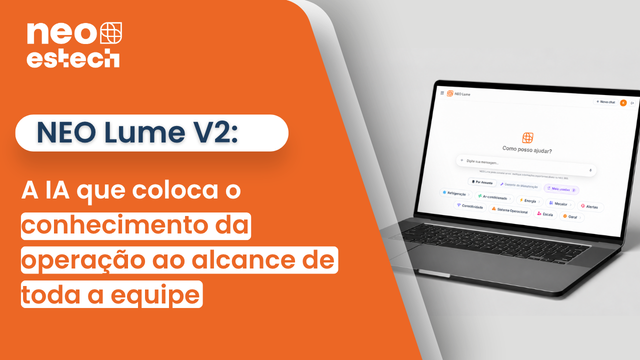
NEO Lume V2 is NEO's Artificial Intelligence, specialized in food retail operations. With this AI, anyone on the team can talk to the operation's data in natural language, just as they would with an experienced colleague.
Instead of navigating screens and filters, users type their question and get a contextualized answer based on their own chain's data. Lume works 24 hours a day, in five languages, and is available both in N3Ogo, the NEO app, and in NEO360, the web version.
With the new version, Lume becomes an operational agent. In other words, besides answering questions, the AI cross-references information, suggests analyses and generates charts and reports from the conversation.
What Lume answers
Lume draws on the platform's main sources of information:
- Management reports: summarizes the performance shown in the weekly and monthly reports.
- Coolsense alerts: explains what the alert indicates. Coolsense is NEO's machine learning engine that identifies eight behavior patterns in refrigerated environments.
- Tickets: shows the status, the history and who is responsible for each step of the response.
- On-call schedule: indicates whom to contact and at what time, according to the chain's response workflow.
- Performance: explains indicators, rankings, compliance and changes in efficiency.
- Procedures and FAQs: walks through the operation step by step.
- Training: points users to the NEO Learning tracks and technical videos.
Different questions for each role
Each role makes different decisions. That is why Lume offers suggested questions for each one. Some examples:
- Director of operations: “Which stores had the most critical incidents this month?”
- Maintenance manager: “Which tickets have been open the longest?”
- Field technician: “What does the Coolsense alert on rack 2 at store 14 mean?”
- Loss prevention: “Which equipment was out of the temperature range yesterday?”
This way, each person gets to the information that matters for their own role faster, without depending on an intermediary.
The answer where the operation happens
Picture a maintenance manager on the way to another store when a rack starts behaving abnormally. From their phone, the question goes straight to Lume. Then the answer arrives with the equipment's history, recent tickets and who is on call.
This way, the decision no longer sits in a queue. Since Lume also generates charts and reports, the same conversation works both for acting in the moment and for taking the topic to the management meeting.
What changes for the operation
With Lume, the knowledge that used to be concentrated in a few specialists becomes available to the whole team. As a result, less time is spent searching for and interpreting information, leaving more time to execute.
In addition, new hires gain autonomy sooner, because they can ask Lume what they would previously have asked an experienced colleague. For management, this means faster decisions and an operation that depends less on the memory of specific people.
Lume within the Asset Management System
NEO Lume V2 is one of the modules of the Asset Management System, the management layer that integrates refrigeration, HVAC, energy, water and automation data and turns it into priorities and actions for each role in the company.
While Smart Notification decides what deserves attention, Lume explains what is happening and why. Together with N3Ogo, NEO Insights and NEO360, these modules make up the NEO Ecosystem.
Monitoring is not the same as deciding.
About NEO Estech
NEO is the Asset Management System for food retail. It connects energy, refrigeration, maintenance, and quality into a single intelligence layer that transforms data into decisions and decisions into results. Monitoring is not the same as deciding.
Your operation already generates data. The next step is turning it into decisions.

 Portuguese
 Spanish
 English
 French